
The investigation starts before you think it does.
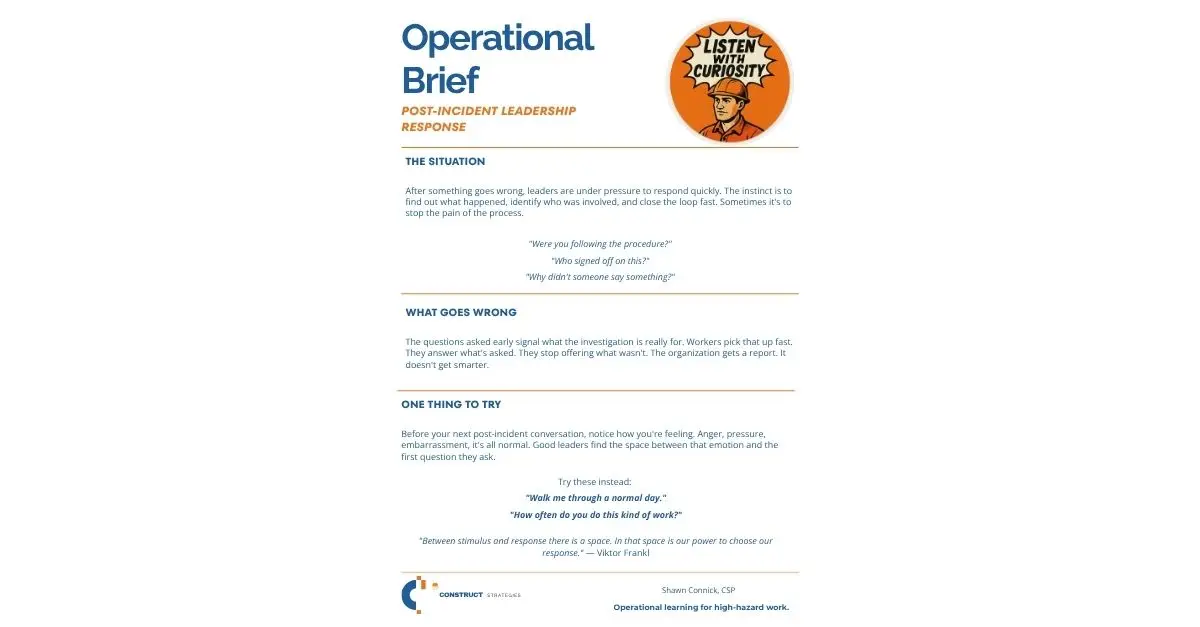
After something goes wrong, leaders are under pressure to respond quickly. The instinct is to find out what happened, identify who was involved, and close the loop fast.
So they ask:
- “Were you following the procedure?”
- “Who signed off on this?”
- “Why didn’t someone say something?”
Those questions signal what the investigation is really for. Workers pick that up fast. They answer what’s asked. They stop offering what wasn’t. The organization gets a report. It doesn’t get smarter.
What goes wrong
The questions asked early define what you learn. If you show up looking for fault, that’s all you’ll find.
One thing to try
Before your next post-incident conversation, notice how you’re feeling. Anger, pressure, embarrassment — it’s all normal. Good leaders find the space between that emotion and the first question they ask.
Try these instead:
- “Walk me through a normal day.”
- “How often do you do this kind of work?”
That’s Operational Learning in practice. Show up curious. Listen without fixing. Learn before you conclude.
“Between stimulus and response there is a space. In that space is our power to choose our response.” — Viktor Frankl
Shawn Connick, CSP — Construct Strategies. Operational learning for high-hazard work. connick.cc